Skip to content

Smartmath.online

Word problems made simple

01.008 In an isosceles triangle, a median is drawn to a side equal to 4

Posted on 29 June 20252 July 2025 By SmartMath

In an isosceles triangle, a median is drawn to a side equal to 4. Find the base of the triangle if the median is 3 long

Solution.

Let’s break down this problem step by step. We have an isosceles triangle. Let the two equal sides be denoted as ‘a’, and the base as ‘b’. We are given that one of the equal sides is 4 cm. Let’s say we have triangle ABC, where AC = BC = 4 cm.

A median is drawn to one of the equal sides. Let’s say the median CD is drawn to side AB. No, that’s not right. The problem states “a median is drawn to a side equal to 4 cm”. This means the median is drawn to one of the *equal* sides, let’s say AC. Let D be the midpoint of AC. So, AD = DC = 2 cm. The median BD is given as 3 cm.

Our goal is to find the length of the base, AB. Let’s call the base ‘x’.

To solve this, we can use the Law of Cosines. Consider triangle ABC. Let the angle at vertex C be \alpha.

Using the Law of Cosines in triangle ABC to find the base ‘x’:

x^2 = AC^2 + BC^2 - 2 \cdot AC \cdot BC \cdot \cos \alpha

Substituting the given values, AC = 4 and BC = 4:

x^2 = 4^2 + 4^2 - 2 \cdot 4 \cdot 4 \cdot \cos \alpha
x^2 = 16 + 16 - 32 \cos \alpha
x^2 = 32 - 32 \cos \alpha \quad (Equation \ 1)

Now, let’s consider the triangle formed by the median. We have triangle BDC, where BC = 4 cm, DC = 2 cm (since D is the midpoint of AC), and the median BD = 3 cm. The angle at C is still \alpha.

Using the Law of Cosines in triangle BDC to find the length of the median ‘m’ (which is 3 cm):

m^2 = BC^2 + DC^2 - 2 \cdot BC \cdot DC \cdot \cos \alpha

Substituting the given values, BC = 4, DC = 2, and m = 3:

3^2 = 4^2 + 2^2 - 2 \cdot 4 \cdot 2 \cdot \cos \alpha
9 = 16 + 4 - 16 \cos \alpha
9 = 20 - 16 \cos \alpha
Now, we can solve this equation for \cos \alpha:
16 \cos \alpha = 20 - 9
16 \cos \alpha = 11
\cos \alpha = \frac{11}{16} \quad (Value \ of \ \cos \alpha)

Now we have the value for \cos \alpha. We can substitute this back into Equation 1 to find x^2:

x^2 = 32 - 32 \left( \frac{11}{16} \right)
x^2 = 32 - 2 \cdot 11
x^2 = 32 - 22
x^2 = 10

To find ‘x’, we take the square root:
x = \sqrt{10}
The length of the base is \sqrt{10} cm.
Answer: \sqrt{10} cm.
Geometry

Post navigation

Previous Post: 01.007 Trapezoid bases: inscribed circle (diameter 15) and leg (17)
Next Post: 10.009 In an isosceles triangle, the base is 16, and a side is 10

Related Posts

10.009 In an isosceles triangle, the base is 16, and a side is 10 Geometry
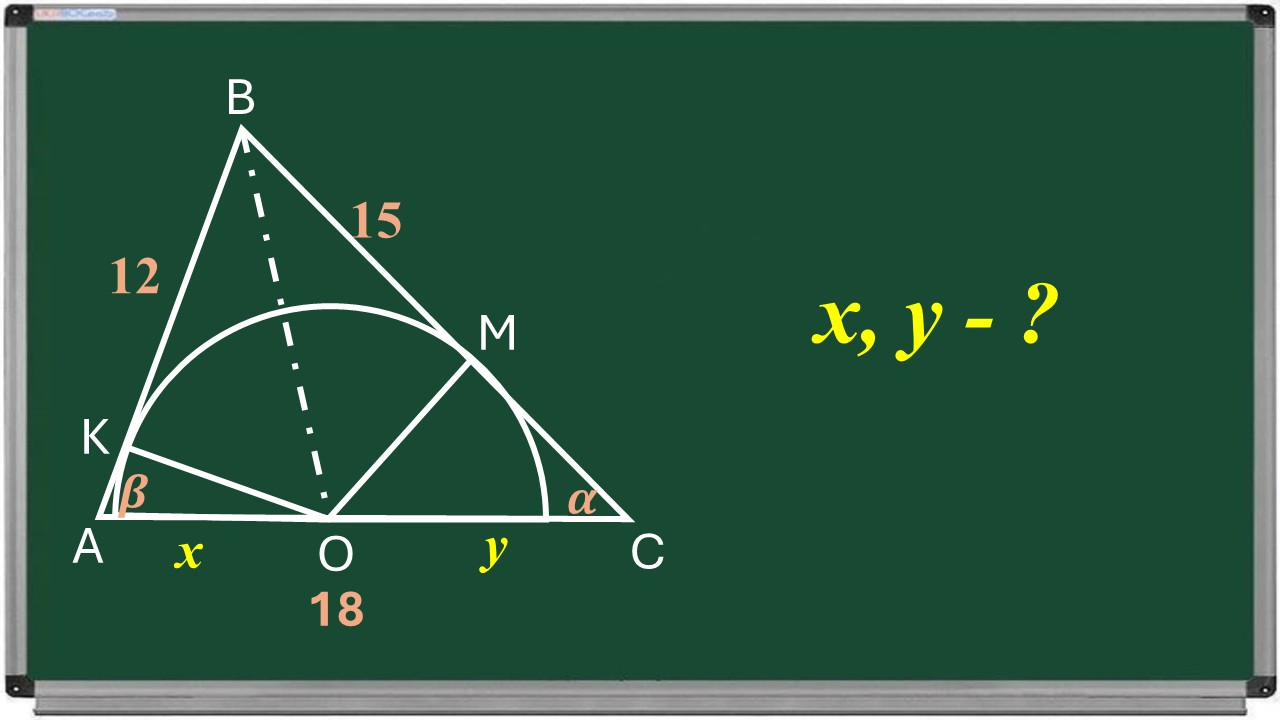
A triangle is given with sides of 12, 15, and 18. Find the segments Geometry
01.003 An isosceles trapezoid has bases of 21 cm and 9 cm, and its height is 8 cm. Find the radius of the circumscribed circle Geometry
01.002 In an isosceles trapezoid with bases 20 and 12, find the diagonal and the leg Geometry
10.010 Each side of an equilateral triangle is divided into three equal parts Geometry
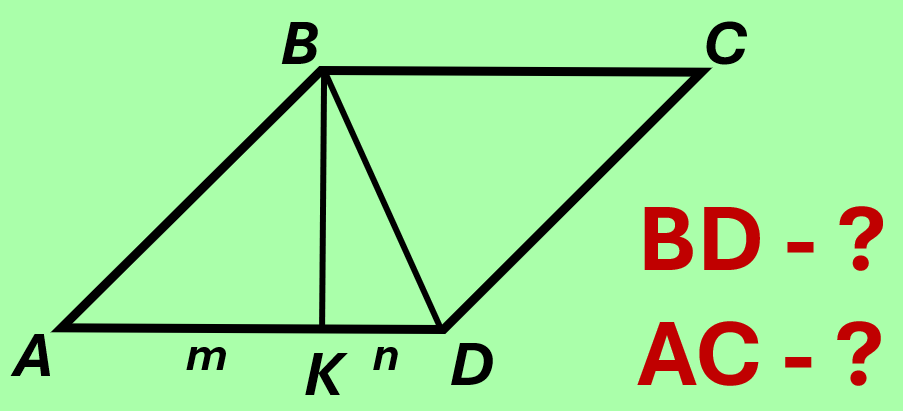
01.004 The height of a rhombus drawn from the vertex of an obtuse angle divides its side into segments of length m and n Geometry

Copyright © 2026 Smartmath.online.

Powered by PressBook Grid Blogs theme