Problem:
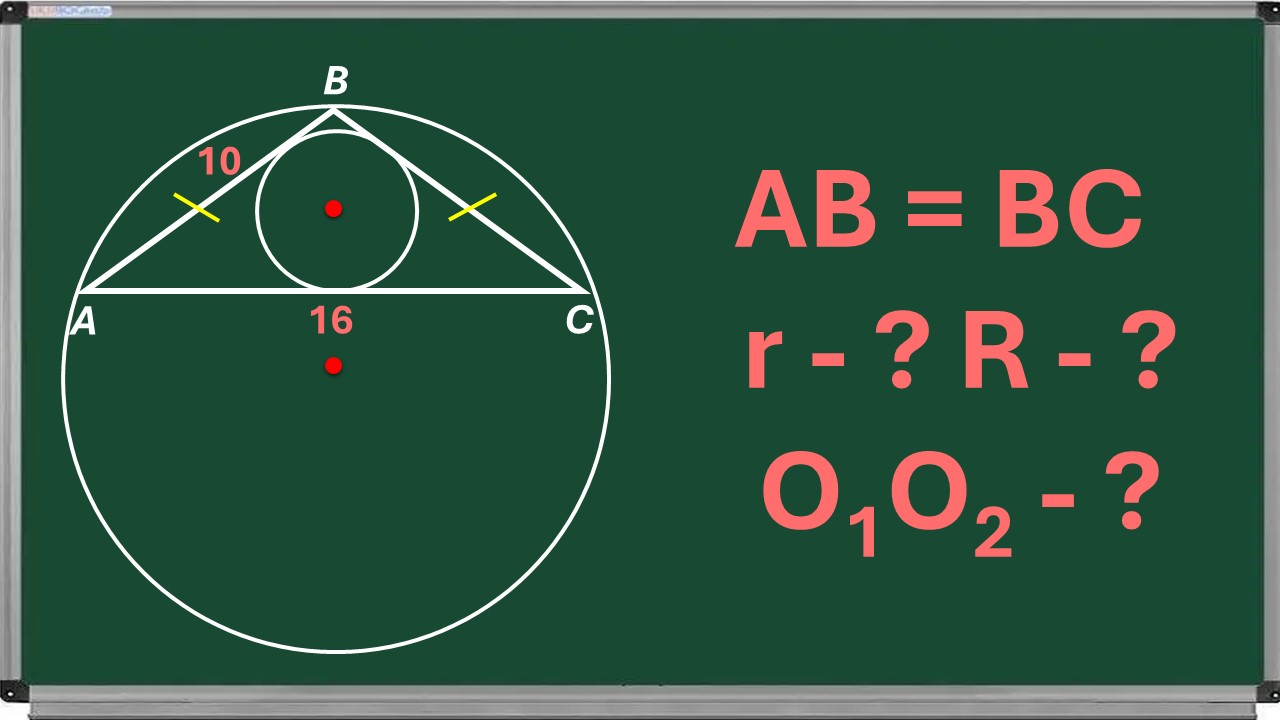
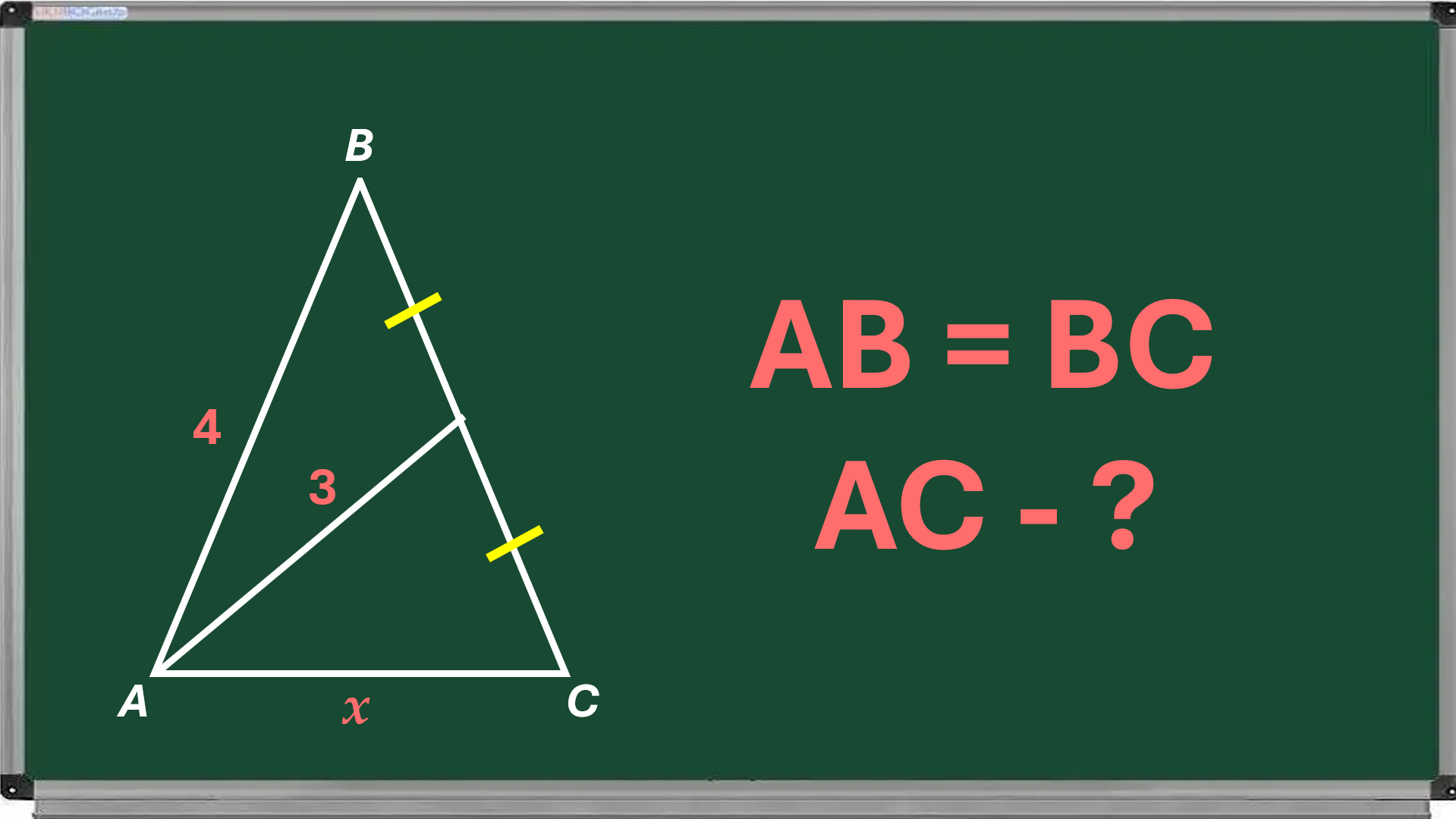
We have an isosceles triangle. Its base is 4\sqrt{2} cm, and the median to a lateral side is 5 cm. We need to find the lengths of the lateral sides of this triangle.
Explanation of the Solution:
Step 1: Understanding the properties of an isosceles triangle and medians.
- What we are going to find in this step: We will recall the key properties of an isosceles triangle that will help us in solving the problem, as well as the properties of medians.
- Why we need to find this: This knowledge is the foundation for further calculations. Without it, we won’t be able to correctly build the logic of the solution.
- Logic:
- In an isosceles triangle (for example, \triangle ABC, where AB = BC), the altitude drawn to the base is also simultaneously a median and an angle bisector. In our case, if BD is the altitude to the base AC, then it also bisects the base AC, meaning AD = DC.
- The point of intersection of the medians of a triangle (in our case, point O) divides each median in a 2:1 ratio, starting from the vertex. This means that, for example, median AM is divided by point O such that AO is twice as long as OM. Similarly, for median BD, if it were a median, then BO would be twice as long as OD.
Step 2: Finding the length of segment AD.
- What we are going to find in this step: The length of half of the triangle’s base.
- Why we need to find this: Since BD is a median to the base AC, it bisects AC. Knowing the length of AC, we can easily find AD, which will be necessary for applying the Pythagorean theorem later.
- Calculations:
- We know that the length of the base AC = 4\sqrt{2} cm.
- Since D is the midpoint of AC, then AD = \frac{1}{2} AC = \frac{1}{2} \cdot 4\sqrt{2} = 2\sqrt{2} cm.
Step 3: Using the property of medians to find AO.
- What we are going to find in this step: The length of segment AO, where A is a vertex of the triangle and O is the intersection point of the medians.
- Why we need to find this: We are given the length of the median AM (5 cm). Since O divides the median AM in a 2:1 ratio, we can find the length of AO, which is a part of this median. This will later allow us to work with the right-angled triangle \triangle AOD.
- Calculations:
- Median AM is divided by point O in a 2:1 ratio, meaning AO : OM = 2 : 1.
- This implies that AO = \frac{2}{3} AM.
- Substitute the known value AM = 5 cm: AO = \frac{2}{3} \cdot 5 = \frac{10}{3} cm.
Step 4: Finding the length of segment OD using the Pythagorean theorem.
- What we are going to find in this step: The length of segment OD, which is part of the altitude BD.
- Why we need to find this: We already know AO and AD. Triangle \triangle AOD is a right-angled triangle, since BD (and thus OD) is the altitude to the base AC. By applying the Pythagorean theorem, we can find OD. This will bring us closer to finding the full length of the altitude BD.
- Calculations:
- In the right-angled triangle \triangle AOD (angle D is a right angle), by the Pythagorean theorem: AO^2 = AD^2 + OD^2.
- From this, OD^2 = AO^2 - AD^2.
- Substitute the known values: OD^2 = \left(\frac{10}{3}\right)^2 - \left(2\sqrt{2}\right)^2 = \frac{100}{9} - (4 \cdot 2) = \frac{100}{9} - 8 = \frac{100}{9} - \frac{72}{9} = \frac{28}{9}.
- Therefore, OD = \sqrt{\frac{28}{9}} = \frac{\sqrt{28}}{3} cm.
Step 5: Finding the length of the altitude BD.
- What we are going to find in this step: The full length of the altitude BD.
- Why we need to find this: The altitude BD is one of the sides of the right-angled triangle \triangle BDC, which we will use to find the lateral side BC.
- Calculations:
- Since O divides the median BD in a 2:1 ratio (although BD is an altitude here, it is also a median, so the division property holds), then BO = 2 \cdot OD.
- Then BD = BO + OD = 2 \cdot OD + OD = 3 \cdot OD.
- BD = 3 \cdot \frac{\sqrt{28}}{3} = \sqrt{28} cm.
Step 6: Finding the length of the lateral side BC using the Pythagorean theorem.
- What we are going to find in this step: The length of the lateral side of the triangle. This is our final goal.
- Why we need to find this: This is the last step in solving the problem. We have a right-angled triangle \triangle BDC (angle D is a right angle), where we know the legs BD and DC. By applying the Pythagorean theorem, we will find the hypotenuse BC, which is the lateral side of the triangle.
- Calculations:
- We know that DC = AD = 2\sqrt{2} cm (from Step 2).
- In the right-angled triangle \triangle BDC, by the Pythagorean theorem: BC^2 = BD^2 + DC^2.
- Substitute the known values: BC^2 = (\sqrt{28})^2 + (2\sqrt{2})^2 = 28 + (4 \cdot 2) = 28 + 8 = 36.
- Therefore, BC = \sqrt{36} = 6 cm.
Answer:
The length of the lateral side of the triangle is 6 cm.